Respect for Human Rights

Kioxia Group recognizes that consideration of human rights is a prerequisite for the sustainable development of companies and of society. In order to respect the human rights of all stakeholders involved in our business activities, including those in our supply chain, we have established respect for human rights as a priority area of focus in terms of ensuring the Group’s medium- to long-term growth, and we refer to this priority area as Sustainability Materiality.

Policy Governing Respect for Human Rights

In 2021, based on our mission, vision and Standards of Conduct, we formulated the Kioxia Human Rights Policy as a way to clarify our corporate responsibility to respect human rights. This policy stipulates that we must fully respect the human rights recognized in the International Bill of Human Rights and other documents, and that we will promote initiatives in accordance with international standards such as the United Nations Guiding Principles on Business and Human Rights (UNGPs). The Kioxia Human Rights Policy constitutes one of our most important sets of regulations, and has been endorsed by the Board of Directors of Kioxia Holdings Corporation.

Kioxia Group is also committed to conducting business activities that are in line with the Responsible Business Alliance (RBA)1 Code of Conduct. Examples include promoting our own sustainability initiatives and requesting our suppliers to respect human rights.

1 Corporate alliance that promotes social responsibility within global supply chains

Kioxia Human Rights Policy Governance

Kioxia Human Rights Policy Governance Kioxia Human Rights Policy Governance

Procedures Regarding Respect for Human Rights

Kioxia Group is implementing procedures that minimize human rights risks in its business activities in order to fulfill its responsibility to respect human rights.

At Kioxia Corporation, the Executive Officer in charge of human resources and administration is designated as the officer responsible for promoting human rights awareness, and staff responsible for raising employee awareness of human rights issues are assigned to the Human Resources and Administration Division. The Executive Officer promotes understanding of the Kioxia Human Rights Policy within the company and monitors the status of compliance.

In addition, the Diversity and Human Rights Due Diligence Task Force, which comprises staff from a variety of business areas, proposes activities in line with the UNGPs. The staff members promote these activities in collaboration with relevant departments and group companies.

These initiatives are reviewed by the Sustainability Committee as part of our sustainability management procedures, with any important issues being submitted to the Board of Directors after discussion at Sustainability Strategy Meetings.

Human Rights Due Diligence

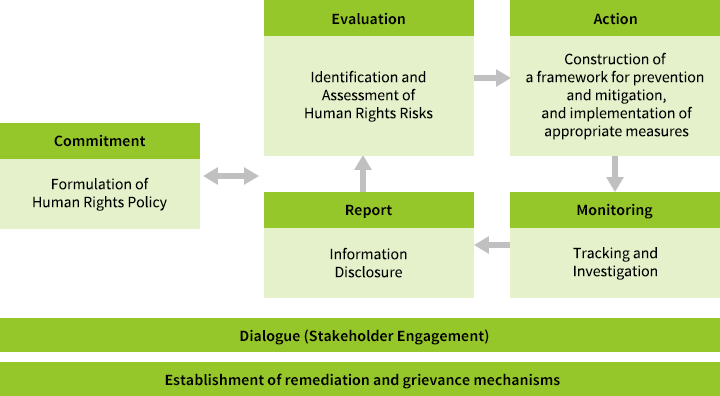
In order to respect the human rights of those impacted by its business activities throughout its overall value chain, Kioxia Group conducts human rights due diligence in accordance with the UNGPs. We are implementing an ongoing cycle of activities aimed at mitigating human rights risks.

These activities include

  • - identifying and assessing any human rights risks
  • - constructing a framework for the prevention and mitigation of these risks
  • - implementing appropriate countermeasures
  • - tracking and investigating any identified situations
  • - disclosing relevant information.

Due Diligence in Kioxia Group

Due Diligence in Kioxia Group Due Diligence in Kioxia Group

Identifying and Assessing Human Rights Risks

Kioxia Group identifies and assesses adverse human rights impacts across its value chain. We also conduct self-assessment surveys, using the RBA Code of Conduct as a reference point for our sustainability activities. We also ask our suppliers to undertake measures to protect human rights in line with this Code of Conduct, including sustainability surveys and responsible mineral sourcing surveys.

With the cooperation of external experts, in FY2021 we conducted human rights risk assessments across Kioxia Group in Japan to evaluate the impact of potential and apparent risks that our business activities might pose to human rights. We subsequently identified 18 human rights risks related to our industry and business model.

Potential Human Rights Risks in Kioxia Group

* Table can be scrolled horizontally.

Labor and employment

  • Forced labor (paying appropriate wages for labor, including in our supply chains)
  • Insufficient employment of people with disabilities
  • Lack of consideration toward sexual minorities
  • Long working hours (including in our supply chains)
  • Abuse of human rights of foreign workers (including technical interns)
  • Harassment of workers

Occupational health and safety

  • Infectious disease-related risks
  • Work related injuries or death
  • Response in cases of mental illness

Environment

  • Negative impact on the living environment of nearby residents

Ethics

  • Procurement of minerals where there is concern about human rights abuses, including the procurement of newly banned rare metals
  • Transactions with customers in countries where there is concern about human rights abuses
  • Lack of supplier education
  • Inadequate/dysfunctional grievance mechanisms (among our suppliers and for contract workers)
  • Impact of product failures on end users
  • Leakage of technologies to countries where human rights abuses occur or misuse of applications for purposes that infringe human rights
  • Response to product safety and other issues caused by data tampering
  • Advertising that raises concerns about human rights abuses

Prevention and Mitigation of Human Rights Risks

Prioritizing Initiatives

Kioxia Group has determined the priority of initiatives aimed at addressing the aforementioned potential risks, taking into consideration the severity of their impact on human rights as well as the Group's level of involvement and response. Each year, we assess the human rights impacts associated with each of these risks and monitor our progress in addressing them. We reflect the results in our targets and initiatives.

Implementing Appropriate Measures

Kioxia Group has focused on minimizing the following human rights risks, utilizing its human rights due diligence procedures and the results of RBA audits at manufacturing sites.

Kioxia Group’s Major Human Rights Measures
  • Kioxia Group Employees

* Table can be scrolled horizontally.

Risks Response Policy Examples and Results of Initiatives

Forced labor

(including paying appropriate wages for labor)

We ensure that all work shall be voluntary.

The Kioxia Group Standards of Conduct stipulate under “Workers’ Human Rights” that it will not employ child labor, forced labor or any other illegal form of labor and will operate an assessment program in line with industry standards to prevent or verify the use of an inappropriate form of labor. We rigorously ensure transparency in recruiting and hiring processes.

  • We have implemented an age verification system that requires a government-issued photo ID from candidates during the hiring process. We have established internal remediation procedures in the event that the use of child labor is discovered. (Kioxia Corporation)
Under a basic policy of fair evaluation and treatment, we observe relevant laws and regulations, pay wages at or above the statutory wage, and ensure timely payment, including appropriate overtime allowances. Furthermore, all workers shall receive equal pay for equal work , regardless of employment category, gender, or other factors.
  • We have revised some of the content regarding disciplinary actions in work regulations. (Kioxia Corporation)
  • Labor and management have agreed on a minimum wage above the legal minimum. (Kioxia Corporation/Kioxia Iwate Corporation/Kioxia Engineering Corporation)
  • We track annual results and disclose information on the gender pay gap (Kioxia Corporation)
  • In FY2025, the wage level of temporary employees was 103.9% that of regular employees. (Kioxia Corporation)

Abuse of human rights of foreign workers

(including technical interns)

We provide equal rights and appropriate working conditions regardless of workers’ nationality.
  • We provide employment contracts and pay slips in the native language of foreign workers, or in a language that they can understand. We have revised documentation regarding investigation and response to costs borne by the employee at the time of hiring. (Kioxia Corporation)
Insufficient employment of people with disabilities
Lack of consideration toward sexual minorities
The Kioxia Group Standards of Conduct stipulate the establishment of workplace environments that are free of discrimination and that respect diversity. This is made known to all employees, and training is also provided.
  • We conduct e-learning training for all employees about preventing discrimination toward LGBTQ+ and other people.
Long working hours We endeavor to respect the laws and regulations of each country and region as well as international rules regarding working hours, holidays, and allocation of leave, with the aim of improving employee health and work-life balance. In addition, we guarantee employees fundamental rights at work and ensure appropriate working conditions through dialogue between labor and management.
  • We implemented a system that enables managers to confirm employees’ annual overtime record at a glance. (Kioxia Group in Japan)
  • We encourage employees to take annual paid leave. For those who work long hours, we arrange interviews with occupational physicians. (Kioxia Group in Japan)
  • We conduct regular discussions regarding long working hours, one example of which is having labor and management review monthly overtime applications. (Kioxia Corporation)
Harassment of workers The Kioxia Group Standards of Conduct stipulate the establishment of workplace environments that are free of harassment. In addition, our work regulations prohibit power harassment, sexual harassment, and harassment related to pregnancy, childbirth, or leave for childcare or nursing care, and designate such conduct as grounds for disciplinary action. This policy is made known to all employees and training is also provided.
  • We provide e-learning training for all employees on harassment prevention.
Response in cases of mental illness To promote the physical and mental health of employees, we promote health management. We have set prevention of stress-related illness as one of our goals, and provide an internal consultation system as well as ongoing mental health education.
  • We provide consultation services through an internal consultation desk.
  • We conduct stress checks and provide each workplace with feedback on the analysis of its results.
  • We conducted a mental health e-learning program for all employees. (FY2025)
  • We held a mental health seminar for managers. (FY2025)
  • Collaboration with external partners

* Table can be scrolled horizontally.

Risks

Response Policy

Examples and Results of Initiatives

Respecting human rights in the supply chain

We promote sustainable procurement throughout our supply chains by complying with the procurement-related laws and regulations, and social norms of each country and region, as well as by building relationships with suppliers based on mutual understanding and trust. We ask our suppliers to implement responsible business practices in accordance with the RBA Code of Conduct, and we strive to conduct our business with consideration for issues such as workers’ human rights, occupational health and safety, and the environment throughout our supply chain.

By collaborating with suppliers, we also promote responsible minerals sourcing (including tin, tantalum, tungsten, gold, and cobalt) in accordance with international rules.

  • Since FY2022, we have continued to promote awareness of and monitor compliance with the RBA Code of Conduct among our suppliers, including staffing agencies and contractors.
  • In FY2024, with the cooperation of subcontractors, we reimbursed foreign migrant workers in the supply chain for employment-related expenses.

Inadequate/dysfunctional grievance mechanisms (including our suppliers)

We have established contact points where all stakeholders, including those in the supply chain, can report and discuss suspected violations of the laws or regulations of each country or region, the Kioxia Group Standards of Conduct, the Kioxia Human Rights Policy, or internal regulations.

  • To strengthen our response to human rights issues in the supply chain, we introduced third-party hotline utilizing JaCER.2 (From April 2025)

Negative impact on the living environment of nearby residents

We emphasize dialogue with local residents living near our business sites. We also strive to reduce the impact of our business activities on natural capital, remain considerate of the local environment, and conduct ongoing conservation activities.

  • We mitigate traffic congestion around our plants by deploying traffic wardens.
  • We engage in biodiversity conservation and social contribution activities in order to coexist with the rich ecosystems in the areas where we operate.

2 Japan Center for Engagement and Remedy on Business and Human Rights (JaCER)

Tracking and Investigation

Kioxia Group regularly monitors its business activities to ensure compliance with the Kioxia Human Rights Policy and checks the progress and effectiveness of corrective actions. We will revise our Human Rights Policy and review our initiatives as appropriate in response to the demands of society, dialogue with stakeholders, and the status of our business operations.

Information Disclosure

The status of Kioxia Group’s initiatives for respecting human rights is updated each year on its website.

Raising Awareness of the Need to Respect Human Rights and Related Training

Kioxia Group provides annual training on human rights and harassment issues for all employees to raise awareness of the human rights expected internationally. In addition, we have made the Harassment Consultation Desk widely known across Group companies.

FY2025 training results are shown below.

Training on Respect for Human Rights (FY2025)

* Table can be scrolled horizontally.

Topic

Target

Results

Human rights training

Kioxia Group

Conducted for all employees as part of Kioxia Group basic training. Participation rate: 100%

Understanding people with disabilities

Kioxia Iwate Corporation

Held two diversity, equity and inclusion (DE&I) workshops with attendance totaling approximately 100 employees, mainly managers and mid-career employees, aimed at creating an inclusive corporate culture open to participation by diverse human resources including people with disabilities

Understanding sexual minorities

Kioxia Corporation

Held training for personnel in charge of human resources

Harassment prevention

Kioxia Corporation

  • Held position-based harassment prevention training at Head Office and Yokohama Technology Campus
  • Held harassment prevention training for all new employees as part of basic training when joining the company
  • Held training on preventing harassment in recruitment activities for all personnel involved in recruitment

Dialogue (Stakeholder Engagement)

We engage in dialogue with stakeholders and communicate Kioxia Group’s human rights initiatives—such as the aforementioned countermeasures and our explanations of the Kioxia Group Supply Chain Code of Conduct to suppliers—through daily business activities and sustainability reports.

Grievance Mechanisms (Remedy Hotlines)

Kioxia Group has established contact points where employees and business partners can report suspected violations of the laws and regulations of each country or region, the Kioxia Group Standards of Conduct, the Kioxia Human Rights Policy, and other internal regulations, and discuss possible remedies.
At each contact point, privacy is protected and confidentiality is strictly observed. We guarantee that whistleblowers and related parties are not subject to disadvantageous treatment due to having made a report. Reported matters are verified in a neutral and fair manner, and appropriate measures are taken.

Harassment Consultation Desk for Employees

Kioxia Group in Japan has established a Harassment Consultation Desk where employees and others can report issues related to various types of harassment. We promote awareness of this service through the intranet and via training for all employees.

In FY2025, the desk received 38 reports and consultations. In cases where we determine that there is or is likely to be an inappropriate situation, we obtain the consent of the individual who made the report or consultation before instructing the relevant department to take corrective action or issuing a warning. Moreover, if an investigation confirms a violation of our internal ethics standards, we take disciplinary action to encourage reflection and prevent recurrence.

Grievance Reporting System for External Stakeholders: JaCER

The Japan Center for Engagement and Remedy on Business and Human Rights (JaCER) offers a non-judicial platform for grievance redress in line with the UNGPs, and acts in a professional capacity to support and promote redress of grievances by regular member companies. Kioxia Group receives reports and consultations regarding suspected human rights violations, primarily related to supply chain issues, through the grievance reporting form provided by JaCER. The form is available in Japanese, English, and Chinese, and anonymous submissions are possible, allowing whistleblowers to report concerns with confidence. Reported matters are handled appropriately, with progress and outcomes disclosed in the grievance list on the JaCER website.

JaCER Grievance Form

Please see the following for information about other whistleblower hotlines

Participation in External Initiatives

Kioxia Group is working to build a more effective grievance mechanism to address human rights issues. In November 2022, Kioxia Corporation became a supporting member of JaCER, which aims to create a shared grievance platform for the industry. In FY2024, through our involvement with JaCER we gained insight into the latest industry developments and examined ways to improve our own grievance handling processes. As a result, we became a regular member in April 2025.