

Climate Change, Initiatives
Efforts to Adapt to Climate Change
Kioxia Group is advancing measures to address climate change throughout the value chain, taking into account the identified risks, opportunities, and their impacts.
Product Development
In the storage product market, demand for low-power-consumption products is very high, and expanded sales opportunities are expected through the development of these products. The Group is engaged in research and development of high-density integration technology to improve energy efficiency during product use and increase storage capacity. Specifically, we are promoting activities with the target of reducing the energy consumption of memory and SSD products per GB of data processed by 30% by FY2030 compared with FY2025.
To understand the environmental impact of products during use and manufacturing, the Group has begun LCA (Life Cycle Assessment)1 calculations for some products. In FY2025, third-party verification was conducted for four products.
- 1 Life Cycle Assessment (LCA): a method for quantitatively evaluating the environmental impact of a product or service throughout its lifecycle (raw material procurement, manufacturing, transport, use, and disposal) or at a specific stage of that lifecycle.
Please refer to “Reducing Environmental Impact through Our Products” for details.
Operations at Manufacturing Sites and R&D Facilities
Under its FY2050 net-zero greenhouse gas goal, Kioxia Group is promoting reductions in both direct emissions (Scope 1) and indirect emissions from the use of purchased energy (Scope 2).
With respect to reducing direct emissions (Scope 1), the Group is actively installing abatement equipment for gases such as PFCs, which have high global warming potential. Since 2011, PFC gas abatement equipment has been installed on 100% of applicable facilities. We are working to improve efficient operation through the introduction of online monitoring using IoT and to enhance abatement performance in cooperation with abatement equipment suppliers. In FY2025, the reduction effect of this abatement equipment for PFC gases amounted to 4.77 million t-CO2.2
The Group has also introduced carbon-neutral city gas.
Reduction Effect of PFC Gas Abatement Equipment on Scope 1 Direct Emissions (t-CO₂)
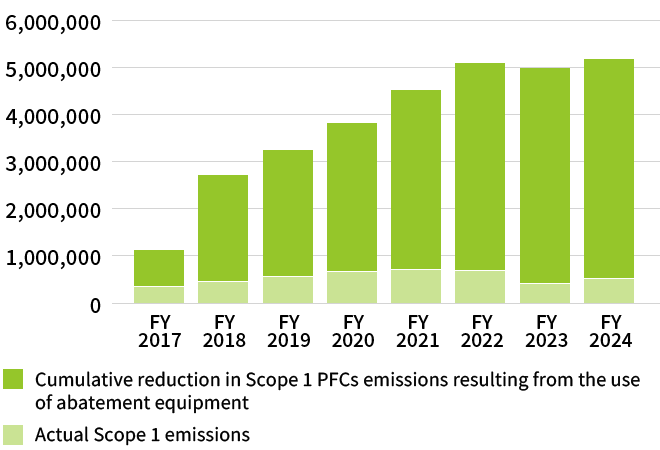
Note: Figures cover Kioxia Corporation, Kioxia Iwate Corporation, and Solid State Storage Technology Corporation (SSSTC from FY2021 onward).
2 Calculated based on IPCC guidelines
With respect to indirect emissions from the use of purchased energy (Scope 2), the Group will pursue reductions through energy-saving and the introduction of renewable energy. Kioxia Group’s manufacturing sites have established energy management systems compliant with ISO 50001. In order to optimize the efficiency of our energy consumption, we have the stated goal of reducing Scope 2 energy consumption by 1% each year compared with the previous fiscal year, in line with the directives contained in the Act on Rationalizing Energy Use and Shifting to Non-fossil Energy (hereinafter, “the Energy-Saving Act”) in Japan. In FY2025, we achieved our goal for emissions reduction through various energy-saving activities, recording an annual reduction of 33,000 t-CO2 against a target of at least 23,000 t-CO2. From FY2017 through FY2025, our energy conservation efforts have resulted in a cumulative reduction of approximately 200,000 t-CO2.
To promote energy saving and efficiency at each site, the Group is working on improvements such as manufacturing and test process efficiency and temperature control of auxiliary equipment, as well as the introduction of new technologies such as smart factories and waste heat utilization. For priority items, a system has been established to review them regularly and confirm improvement effects and progress.
Value Chain
As climate change progresses, including global warming, natural disasters such as typhoons and flooding caused by heavy rain occur almost every year. As a result, the risk has become apparent that suppliers’ production and logistics may be affected, causing disruptions to Kioxia Group’s production system and product supply. Kioxia Group includes all business sites within the scope of its business continuity management (BCM) policy, and has established response protocols that address a variety of risks, including natural disasters. Under the Group’s BCM policy, we strive in normal times to understand the status of materials and products and to diversify suppliers. In emergencies, we have established a system to quickly assess impacts and work in coordination toward early recovery, thereby minimizing the impact on business.
Addressing climate change is also an important issue for our customers and suppliers. Through the CDP Supply Chain Program, the Group collects information on environmental impacts from major suppliers and analyzes it to support reductions in its own Scope 3 emissions. In FY2025, we engaged with suppliers accounting for more than 90% of our Scope 3 greenhouse gas emissions, encouraging them to reduce emissions and adopt renewable energy. In particular, for suppliers with a large impact on the Group’s Scope 3 emissions, issues and responses are shared through individual dialogue. In FY2025, we conducted individual consultations on environmental impact reduction with multiple suppliers accounting for around 40% of our total procurement value.
Looking ahead, we will continue to promote initiatives across the entire value chain toward expanding the market for products that contribute to environmental sustainability and realizing a decarbonized society.
Participation in External Climate Change Initiatives
Kioxia Group is helping to address climate change, gathering information and making recommendations to the government through participation in industry associations and other activities.
Kioxia Holdings Corporation has joined the GX Future Consortium and GX Future League in order to participate in initiatives promoted by the Japanese government for a smooth transition to a decarbonized, growth-oriented economic structure. In 2024, we also joined the Semiconductor Climate Consortium (SCC), established by the industry association Semiconductor Equipment and Materials International (SEMI). As a member of the semiconductor value chain, we are accelerating our efforts to address climate change.
As a member of the Semiconductor Environment Subcommittee of the Semiconductor Board of the Japan Electronics and Information Technology Industries Association (JEITA), a group representing the electronic device industry, Kioxia Corporation is gathering information on new technologies, substitute materials, and emissions measurement technologies to help reduce emissions of greenhouse gases used in the semiconductor manufacturing process, and is promoting emissions reduction. We are also a supporting member of the Japan Climate Leaders’ Partnership (JCLP), a corporate alliance that aims to achieve a decarbonized society. Through this membership we participate in discussions on measures to achieve the 1.5 °C target stipulated in the Paris Agreement and on policy recommendations to the government.


